How to use a compass – a beginners guide
Knowing how to use a compass is one of the most useful skills you can learn for walking and exploring outdoors.
Even with GPS on your phone, a compass helps you stay on track when signal drops or visibility is poor. It also builds confidence when you are exploring new places.
This guide explains the basics in simple steps. You will learn what a compass does, how to take a bearing, and how to follow it on the ground.
If you need a quick answer, or want to refresh your memory on how to use a compass follow these four steps:
How to use a compass (quick steps)
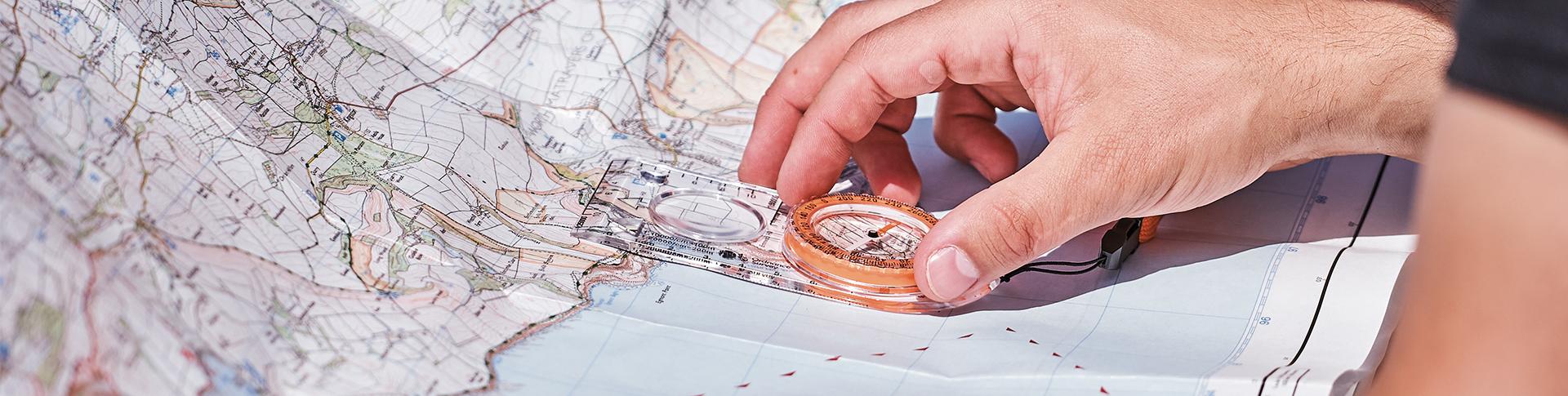
- Place your compass on the map between your start and destination
- Turn the dial so the grid lines match the map’s north lines
- Hold the compass in front of you and line up the needle with north
- Follow the direction of travel arrow
These steps will get you moving in the right direction. The sections below explain each stage of using a compass in more detail.
What is a compass used for?
A compass helps you understand direction. It allows you to:
- see which way you are travelling
- align your map with the landscape
- work out the direction of a destination
- walk in a straight line using a bearing
Together with a map, it forms the foundation of navigation.
What is a bearing?
A bearing is the direction you need to travel, measured in degrees from north.
A compass is marked from 0 to 360 degrees. North is 0 or 360 degrees, east is 90 degrees, south is 180 degrees, and west is 270 degrees.
You do not need to remember the numbers when starting out. The key is understanding that a bearing gives you a precise direction to follow.
Understanding the parts of a compass
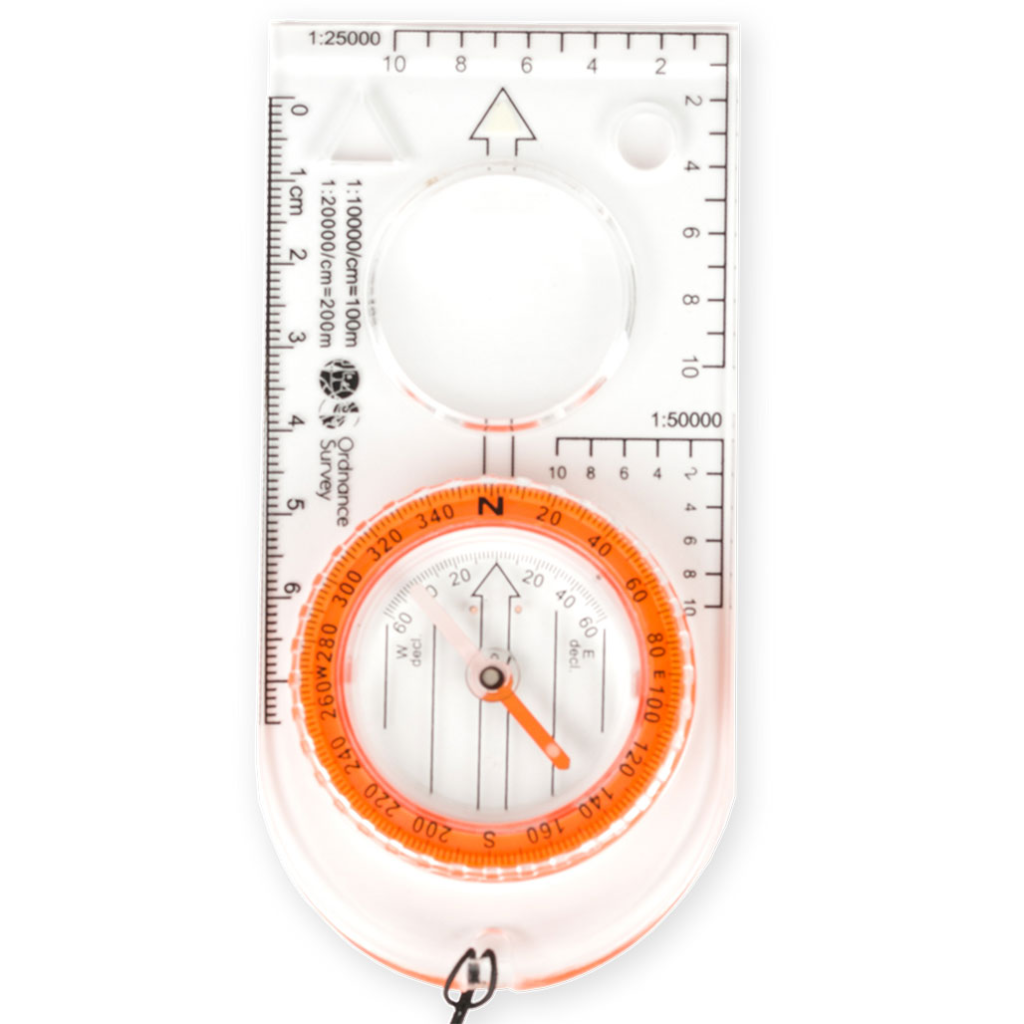
Before you start, it helps to recognise the key parts:
- Baseplate. The flat edge used for lining up routes
- Compass needle. The red end always points north
- Rotating bezel or dial. Marked with 360 degrees
- Orienting lines and arrow. Used to match map grid lines
- Direction of travel arrow. Shows the way you need to walk
You do not need to memorise everything straight away. Focus on how they work together.
Watch: how to use a compass with Steve Backshall
In this video guide, explorer Steve Backshall shows you how to use a compass to navigate from one point to another on your map.
Step-by-step: how to use a compass with a map
Step 1: Line Up Your Points
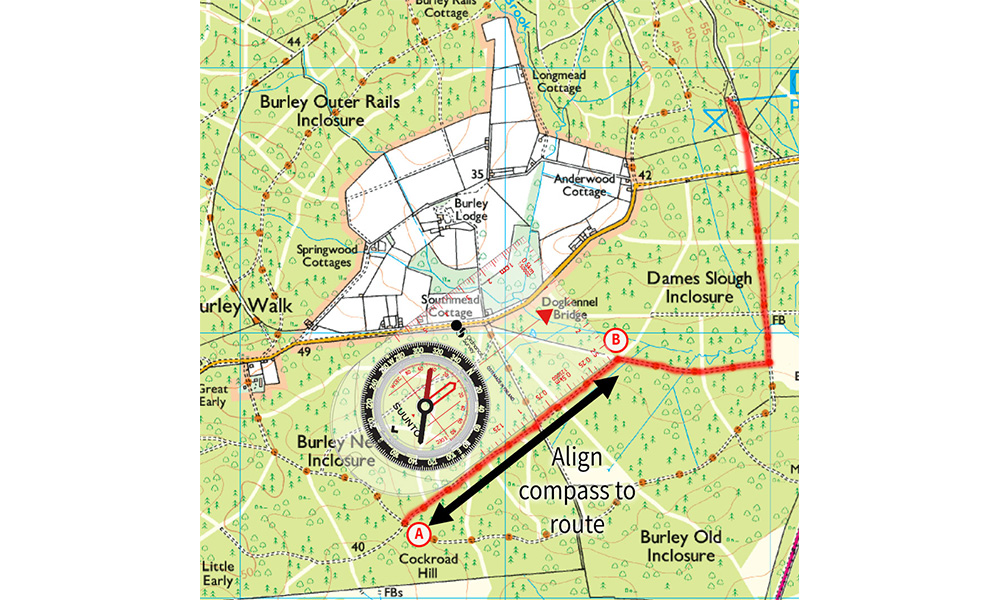
- Find your starting point and destination. You need to know where you are on the map (point A) and where you want to go to (point B).
- Line up point A and B with either the side of your compass or one of the black lines running down the base plate
- Make sure the direction of travel arrow points towards your destination
- A compass with a larger base is useful for covering longer distances, but you can use a straight edge with a smaller compass.
Top Tip
Get the map flat – a stiff map case, flat rock or your knee works.
Step 2: Align to Grid North
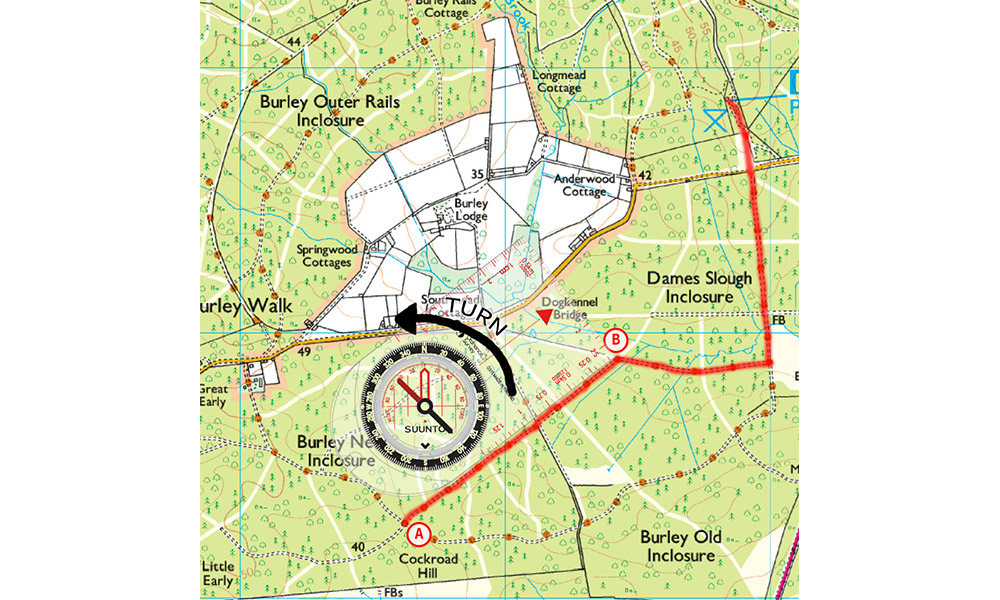
- Now, hold the compass still and turn the compass housing bezel so that the “N” on the bezel and the orienteering arrow are point to grid north (the top of the map).
- Line up the orienting lines with the map’s north-south grid lines
- Ensure the orienting arrow points to the top of the map
You have now set your bearing.
Try to get this as accurate as possible – and if you have folded your map check which way is north!
Ignore what the compass needle is doing at this stage.
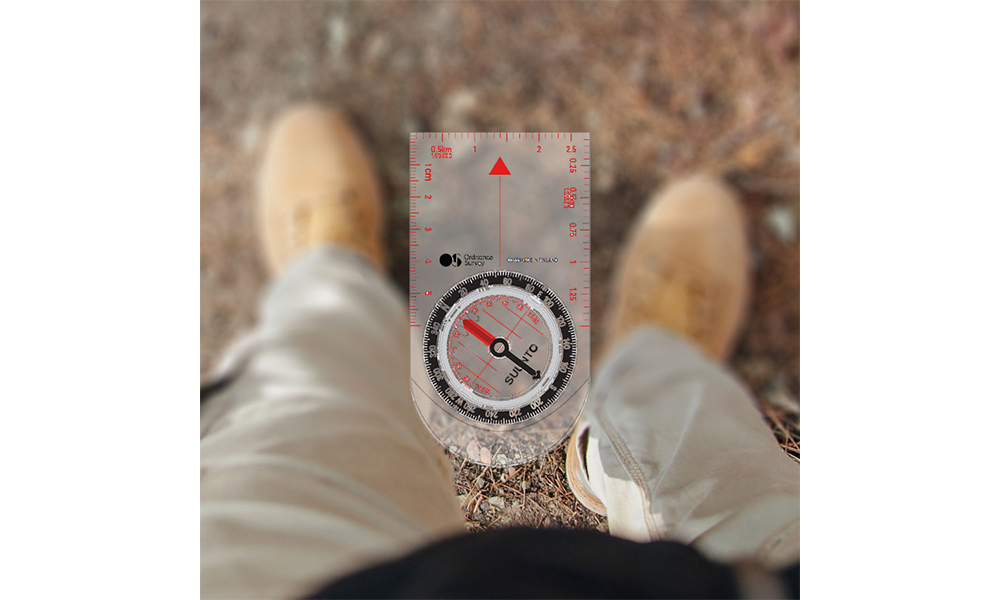
Step 3: Hold the compass and align the needle
- Lift the compass off the map
- Hold it flat in front of your body
- Turn your whole body until the red needle lines up with the orienting arrow
This is often called “putting red in the shed”.
Step 4. Follow your direction of travel
- Look along the direction of travel arrow – that’s the way you are going, towards your chosen point B.
- Pick a fixed feature in the distance such as a distinctive tree, rock, hill peak or similar
- Walk towards it
- Repeat as needed
Try to avoid looking at the compass all the time as you walk, as this is less accurate than using a more distant target. If you reach the target you are aiming for check the compass again, pick a new target object and carry on until you reach your next waypoint.
Don’t Move the Bezel!
The two biggest errors by beginners are: Moving the bezel – it’s set and should not be changed at this point. Secondly, not holding the compass pointing directly away from the body. Also, be aware of any magnets or metal near the compass: mobile phones, magnetic buttons, metal belts and similar can ‘deflect’ the compass needle, making it inaccurate.
Do you need to adjust for magnetic variation?
For most beginner walks in the UK, you can ignore magnetic variation.
In Great Britain, the difference between grid north and magnetic north is small. As your confidence grows, you can learn to include it for greater accuracy, especially in remote or featureless areas.
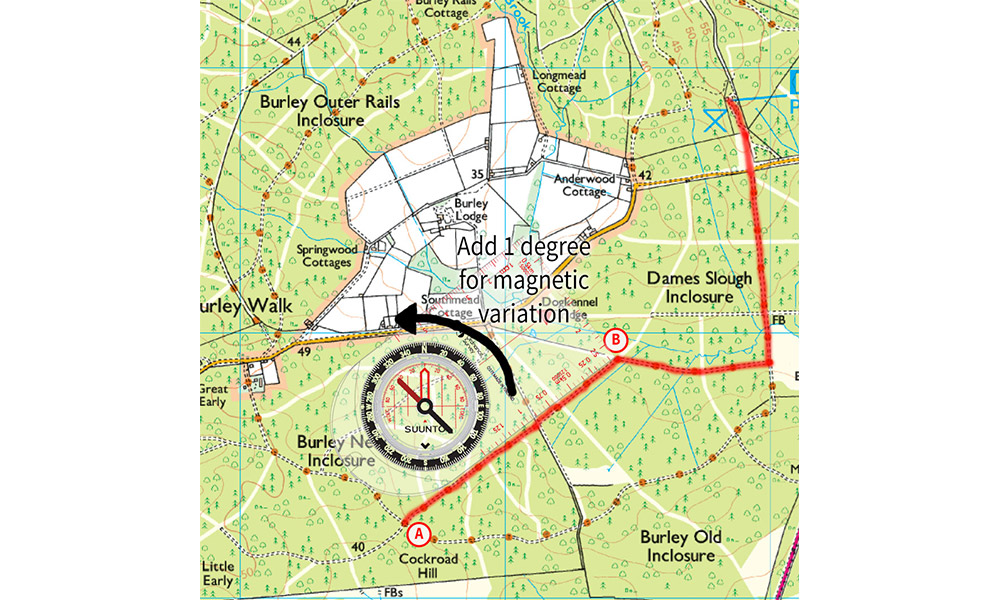
We’re lucky in the UK that this variation is small, but where accuracy is important, you need to adjust for it. The adjustment varies across the country and you can generally find it printed on your map in the key. Look for ‘magnetic north’. Ignore any references to ‘true north’ as we don’t need them. At the moment GB magnetic variations are between -1° and 4°.
Pick up your compass and turn your compass bezel anticlockwise to ADD the positive magnetic variations, or clockwise to SUBTRACT negative variations.
Many compasses have a smaller scale inside the compass housing to make this easier, or use the outer scale. Most compasses only show a marker for every 2 degrees.
With such a small variation for Great Britain you can often ignore it, but it can become critical in some parts of the world or in featureless areas.
Top Tips for Beginners
Always hold the compass flat to keep the needle steady
Keep it away from phones or metal objects
Use clear landmarks rather than moving objects
Practice in an area you already know
Check your direction regularly, especially at junctions
Practicing with your compass builds confidence
The best way to learn is to practise on familiar ground.
Try planning a short local walk and using your compass at each turning point. This helps you build confidence without the risk of getting lost.
You can explore ready-made routes and plan your own using OS Maps.
Test Yourself – Practice Route
Here’s a practice route showing the settings for each leg.
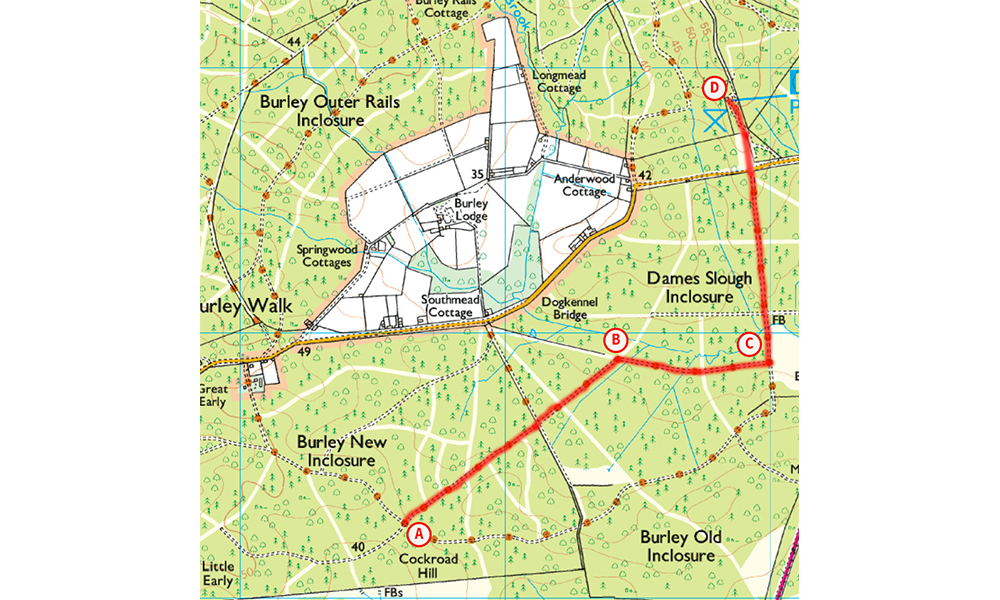
A to B
SU 236 042 to SU 244 048
Initial measurement: 52° from north
Add 1° for variation
Heading: 53°, distance: 1.01 km
B to C
SU 244 048 to SU 250 048
Initial measurement: 91° from north
Add 1° for variation
Heading: 92°, distance: 0.59 km
I’ve ignored the slight kink in this path, but in poor conditions add an intermediate waypoint.
C to D
SU 250 048 to SU 249 058
Initial measurement: 352° (just off true north)
Add 1° for variation
Heading: 353°, distance: 0.96 km
Frequently asked questions
GPS and apps like OS Maps are REALLY useful, but technology can fail due to battery life or signal. A compass works anywhere and helps you navigate with confidence in poor visibility. You should make sure your compass is attached securely to you so you don’t lose it.
Yes, a compass can show direction on its own, helping you head north, south, east or west. However, it is much more useful when used with a map to plan and follow a route.
Yes! The most common cause is nearby magnet such as one on a phone case or jacket, or electrical devices like mobile phones. Keep your compass away from these in use. Some places like the Cullin Hills also have magnetic rocks that can affect a compass, but this is rare
A compass is very accurate when used correctly. In the UK, it will usually point within a degree or two of magnetic north, which is accurate enough for most walking and outdoor navigation.
For beginners, this level of accuracy is more than sufficient, especially on paths and in familiar terrain.
Which compass is best for me?
In some sense, all compasses do the same job but not everyone uses them for the same purpose. There are many different models with variations in features, accuracy and functionality. We take a look at some of the best on the market to help you decide which compass is right for you.
What Kind of Compass do I Need
Improve your map reading skills with this beginner’s guide to the compass. We take a look at the different types of compass, such as a baseplate compass, and explain how to orientate a map with one.
How Learning to Navigate Made My Walking Holiday Better
How learning to navigate can improve even a well sign posted walk by engaging you more deeply with views and terrain
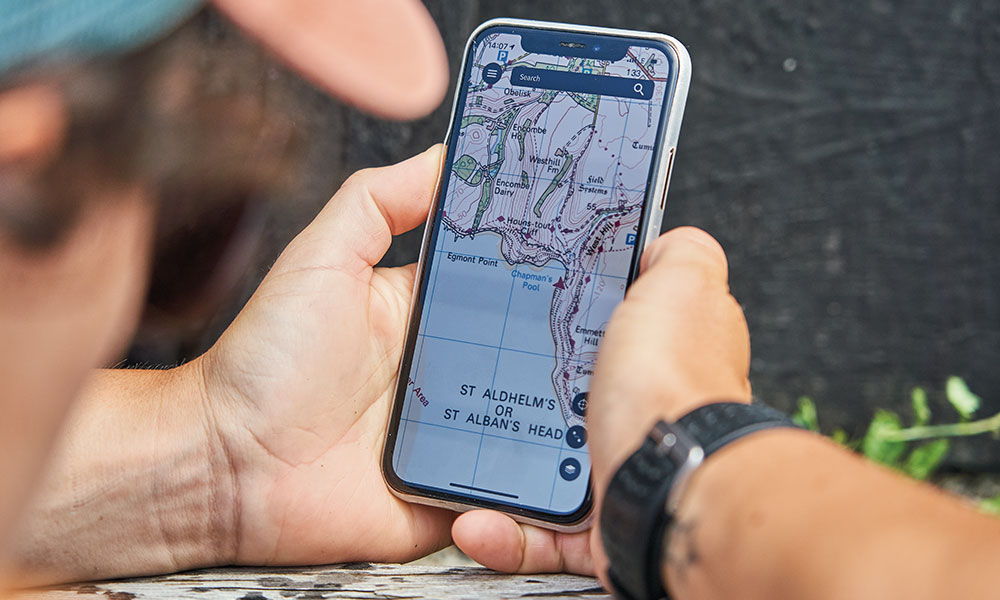
Free Map Reading Guides
Brush up on your map reading skills with these free guides from National Map Reading Week suitable for total beginners, expert navigators and even kids.
An Advanced Guide to Measuring Distance
Enhance your navigation skills and confidence with our advanced guide on how to calculate and measure distance on a map.
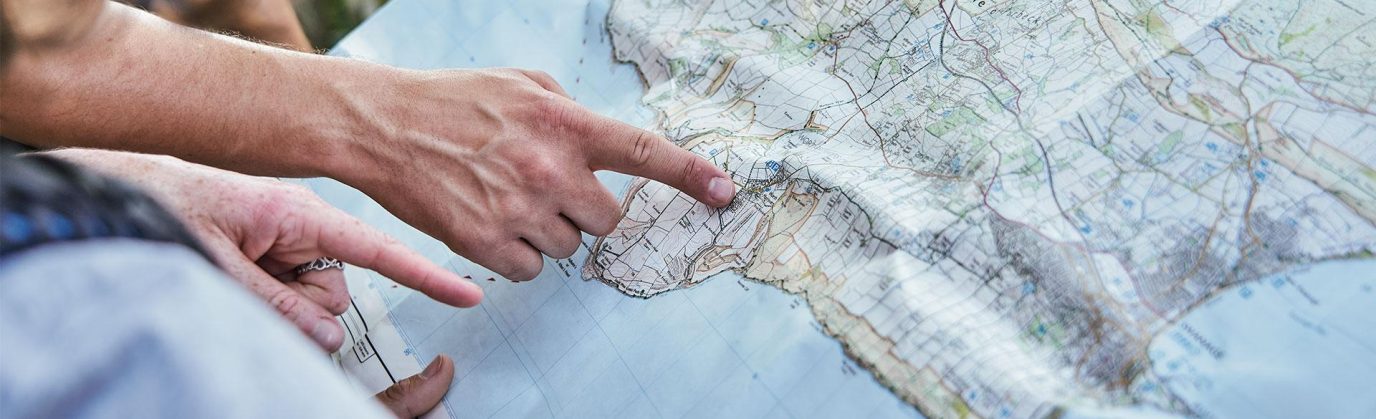
A Beginner’s Guide to Grid References
Improve your map reading skills by learning how to read a 4-figure, 6-figure or 8-figure national grid reference. This grid reference finder is suitable for beginners and includes short ‘how to’ videos.
You can find more navigation and map reading tips here including this basic guide to the different types of compass. You can buy maps to help your practice. Find out which compass is best for you and your chosen activities.
Want to find out more about getting out into the hills and mountains? Read our Hiking For Beginners Guide